Showing posts with label NATO. Show all posts

Sunday, September 13, 2015

Why Stephen Harper and Thomas Mulcair Have Got it so Wrong on ISIS


Recently the Toronto Star posted a piece on Thomas Mulcair and the fight against ISIS:  Mulcair Would Pull Canada From U.S. Led Mission in Mid-East if Elected.

This is a big mistake, not only politically, but from a humanitarian angle.  There is no argument that George Bush's ill-conceived war in Iraq, or in fact the decades of invasions in the region, gave rise to ISIS; but abandonment is not the answer.

As part of his reasoning, Mulcair claims that this is neither a NATO nor a UN mission, but he is wrong. Nato is involved and were involved in most, if not all, engagements in the Middle East.  The United Nations has resolved to stop the flow of money and arms going to ISIS, but many of the arms they are using, are those left by the Americans

And the NATO missions that Mulcair is promoting, have destabilized
 regions, making them ripe for terrorist takeover.  You can be a pacifist and oppose war, but if you support any war, you are no longer a pacifist. His stand is a bit confusing.

As to stopping the flow of money going to ISIS that too will be difficult.  The west has been bombing oil refineries, one source of revenue, and some nations are refusing to pay ransoms, and yet the organization is still able to pay their bills, as well as provide money to run, according to the Economist, "services across the areas it controls, paying schoolteachers and providing for the poor and widowed."

We run the risk of further alienating the occupied, if ISIS can blame the west for not being able to take care of the people.  We need to stop bombing, but we can't just leave.  Humanitarian aid and training is still necessary.

Radicalization and NDP Naivete

When Stephen Harper announced that he would stop Canadians from travelling to countries engaged in "terrorist" activities, Mulcair said he would support the initiative, but questioned whether it would help in the fight against "terrorism".  He went on to say that C-51 did not do enough to combat the "radicalization of youth".

This was actually a topic for debate in the Commons, as the NDP tried to push through an amendment to C-51, reading in part, that the Bill "...does not include the type of concrete, effective measures that have been proven to work, such as providing support to communities that are struggling to counter radicalization.

What communities do they mean?

I rarely agree with anything Peter Van Loan says, but he did raise the issue that it was "ill defined".  Do they mean Muslim communities?  Peter Julian had this to say:
The mosque that is in my riding in Burnaby—New Westminster was the mosque the man who murdered Cpl. Nathan Cirillo attended. I travelled to that mosque within a couple of days of what happened on October 22 here on the Hill. What the mosque members told me was quite stark. They said that they knew he had profound mental illness. They knew that he had a drug addiction. They tried to seek help, and there was nothing available. This is something we have heard from communities right across the country.
It sounds like the issue is more about mental illness and drug addiction, issues that are discussed in many places, and not confined to Mosques.  It would appear that the NDP believe, like the Conservatives, that terrorism is associated with Islam.  This is not only Xenophobic but incorrect.  While the Islamic State is using the religious angle, their motives are not religious, but political.

According to Huffington Post, Yusuf Sarwar and Mohammed Ahmed, the two Brits who went to Syria to join the rebels, first purchased off Amazon, two books:  Islam for Dummies and The Koran for Dummies  They were not devout Muslims.  Nor were the 9/11 hijackers who reportedly used cocaine, drank alcohol, slept with prostitutes and attended strip clubs, but never belonged to a mosque. 

A 2008 report published in the Guardian, dispelled the stereotypes of those who become involved in terrorism:   " They are mostly British nationals, not illegal immigrants and, far from being Islamist fundamentalists, most are religious novices. Nor, the analysis says, are they "mad and bad". and "Far from being religious zealots, a large number of those involved in terrorism do not practise their faith regularly."

Didier François, a French journalist who was held by Isis in Syria for ten months before being released in April 2014, has provided some insight into the life of those fighting for ISIS, in a CNN interview.
“There was never really discussion about texts.  It was not a religious discussion. It was a political discussion.  It was more hammering what they were believing than teaching us about the Quran. Because it has nothing to do with the Quran. We didn’t even have the Quran. They didn’t want even to give us a Quran.”
This is a political movement, not a Jihad one.  President Obama has been trying to stress that, but his words are falling on deaf ears. I often learn a lot by reading the comments section of media reports, and in one, there is a debate between two readers.  One was trying to stress that all terrorists are Muslim but their opponent fired back by saying: "Christians are also terrorists.  They just call it 'shock and awe'".

It is not religion that is fuelling this war, it's war itself.

The Radicalization of Youth Has Little to do With Communities

Al Jazeera also published the results of a study, defining the risk factors for  violent radicalization:  Youth, wealth and academia appear to predispose individuals to sympathizing with acts of terrorism.

Perhaps surprisingly, religious practice, mental health, social inequality and political engagement were not significant factors.
“We’re offering a new paradigm for sympathies as an early phase of radicalization that can be measured,” Kamaldeep Bhui, the study's lead author and a cultural psychology professor at the university, told Al Jazeera. 
While just 2.4 percent of people expressed some sympathy for violence overall, researchers found that those under the age 20, those in full-time education rather than employment, and those with annual incomes above $125,000 were more prone to express sympathy for violent protests and "terrorism."
The attack on Parliament Hill was perpetrated by a mentally ill, homeless man, but mental illness is a separate issue, just as drug addiction and homelessness are.
“One explanation for homegrown terrorism in high-income countries is that it’s about inequality-related grievances," Bhui said in a phone interview. "We were surprised that [the] inequality paradigm seems not to be supported. The study essentially seemed to show that those born in the U.K. consistent with the radicalization paradigm are actually more affluent or well off.” 
Two other findings stood in conflict with prevailing stereotypes about so-called homegrown terrorism in the West: Immigrants and those who speak a non-English language at home, as well as those who reported suffering from anxiety or depression, were less likely to express sympathy for terrorist acts.
If we really want to "stop the flow", we need to stop invading countries, and taking part in "regime changes", simply because they are not willing to conduct business on our terms. Many of the sympathizers are well educated, and intelligent enough to know that there have been grave injustices committed, while society at large blames the victims.  Who are the "terrorists"?

I agree with supporting "at risk" communities, dealing with poverty and youth unemployment, but that will not stop terrorists.  As studies have found, they are not poor, uneducated or unemployed and rarely religious.  In fact, the stereotypical description of radicalized youth, are often the ones who believe that all terrorists are Muslims.

That's where we have to "stop the flow".  Misinformation.


Wednesday, September 8, 2010

What is Stephen Harper up to Now? This Man is Dangerous

As Harper and his army of misfits have been posturing in the North, a story of immense military build-up in the area should be troubling to Canadians.

This is a government with it's head stuck in the Cold War and you can just imagine their "base" salivating and chanting "get those Ruskies".

Military exercises are one thing, and so is the appearance of an alliance as a deterrent, but the game that Harper and MacKay are playing is a dangerous one indeed.

After visits by Canada's defense and military chiefs to inspect the multinational war games, Prime Minister Harper arrived in Resolute on August 25, the penultimate day of the 20-day military maneuvers, to - in the words of one of the nation's main news agencies - rally the 1,500 Canadian, American and Danish troops present.

Harper's visit to inspect the exercise occurred only hours after another - potentially dangerous - publicity stunt by his government: Dispatching CF-18 fighter jets (variants of the American F/A-18 Hornet) to allegedly ward off two Russian Tupolev Tu-95 (Bear) strategic bombers patrolling off Canada's northern border, "something the Russian military does frequently." Harper's press secretary, Dimitri Soudas, "said the two CF-18 Hornet fighters visually identified the two Russian aircraft approximately 120 nautical miles north of Inuvik in Northwest Territories," over international waters.The timing of the Canadian action, as that of its announcement, was calculated. As was a comparable incident in February of 2009 when then recently installed U.S. President Barack Obama paid his first visit abroad to Ottawa, to meet with Harper, and his host scrambled warplanes to intercept a Russian Tu-95 bomber - on a routine mission thousands of kilometers from the Canadian capital - in a show of bravado and of loyalty to his ally south of the border.

"The Russians said then the plane never encroached on Canadian airspace and that Canada had been told about the flight beforehand." [18] Last year Canada's prime minister and defence minister made the following comments:Harper: “We have scrambled F-18 [CF-18] jets in the past, and they’ll always be there to meet them.” MacKay: “When we see a Russian Bear [Tu-95] approaching Canadian air space, we meet them with an F-18.” A few days before Operation Nanook began, July 28, Canada also deployed CF-18 fighters against Russian Tu-95 bombers "as debate rage[d] over whether Canada needs the next generation of fighter jets to replace the nearly 30-year-old CF 18s. The Harper government has committed to buying 65 F-35 stealth fighters at a cost of $9 billion. Critics have said such Cold War-type jets are no longer needed."

I attended an all-candidates meeting in Kingston last night, as our local Liberals are looking to replace Peter Milliken, now that he is retiring, and the question of Arctic sovereignty was raised. The answers all round were good, but two things were stressed. Moral sovereignty and diplomacy.

Two notions that would be completely alien to this government.

Tuesday, August 24, 2010

If He Had Been the First Prime Minister Ignatieff


A CULTURE OF DEFIANCE: History of the Reform-Conservative Party of Canada

My library has a running book sale to raise money for various library events, and yesterday I picked up a 1987 book compiled and published by Mel Hurtig: If I Were Prime Minister.

Each chapter was written by a prominent Canadian who details what they would do if they led the country.

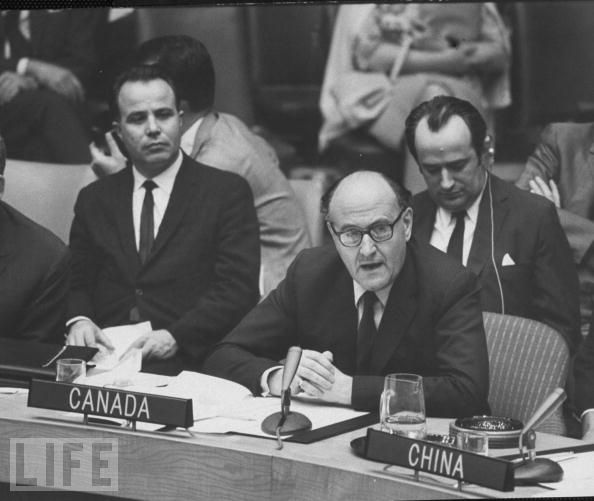
One of those prominent Canadians in 1987 was George Ignatieff, who is shown above in Life Magazine, the one with glasses. I presented a brief history of Michael Ignatieff's family before, but thought these musings of his dad's were worth sharing. They outline a vision that is now, in most areas, the same vision held by his son.

So Who Exactly is George Ignatieff?

George Ignatieff, according to his Trinity College profile, was "A Canadian Ambassador of Peace." That's quite a statement, but defines him in a nutshell. When working under John Diefenbaker, he tried to broker a deal with President Kennedy over our accepting nuclear warheads. Ignatieff was opposed, but as a diplomat, tried to reach a compromise.
Ignatieff, although a diplomatic realist, was also an indefatigable champion of disarmament, and he sought to provide Diefenbaker with a formula that he could use with Kennedy in articulating the near-incomprehensibility of Canada's official position on warheads. The urbane diplomat proposed that the prime minister say he would accept warheads on two conditions: first, if there were joint control in their use — a joint control of Diefenbaker's particular definition; and second, only if an all-out effort at disarmament were launched first and if, at the end, it was determined that there could be no progress.

That formula would buy Diefenbaker some time and it might well wash politically in Canada, even if it wouldn't in Washington. "Making clear-cut decisions was not part of Diefenbaker's nature," Ignatieff later remarked. (1)

And according to Trinity, where there is a theatre named in his honour:
In 1984, he [George Ignatieff] received the Pearson Peace Medal by the United Nations Association in Canada. The Pearson Peace Medal recognizes, in Lester B. Pearson’s name, Canadians who, through voluntary work or other efforts, have contributed to those causes for which Lester Pearson stood: aid to the developing world, mediation between those confronting one another with arms, succor to refugees and others in need, and peaceful change through world law and world organizations.

George Ignatieff enjoyed a distinguished career in international service. He was Canadian Ambassador to Yugoslavia from 1956 to 1958 and Assistant Under-Secretary of State for External Affairs from 1960 to 1962. In successive appointments between 1963 and 1972, he was Canada’s permanent representative to the North Atlantic Treaty Organization; the United Nations, including the Security Council; the Committee on Disarmament; the General Agreement on Tariffs and Trade and the United Nations in Geneva. He was a Companion of the Order of Canada, a member of the Atlantic Council and the Canadian Pugwash Group on Disarmament, and former President of the United Nations Association in Canada.
It's a shame that Canadians don't get to know this, because it helps to define the kind of prime minister Michael Ignatieff will be. Diplomacy and leadership are in his veins. But it explains why the Conservative Party spent ten million dollars on "Just Visiting" ads. They can't let us know just how Canadian Michael Ignatieff really is.

If I were Prime Minister By: George Ignatieff

Following are some excerpts from Michael's father, with his dreams for Canada. He starts out with a goal of nuclear disarmament, his life's passion, then moves onto other areas.

- The duty of a prime minister is to serve the vital interests of the Canadian people. In an age dominated by revolutionary changes wrought by science and technology, including the threat to survival by the risks of nuclear war, top priority must be given to trying to ensure survival. The dangers of nuclear war must be kept in check by active Canadian participation in negotiations for drastic arms limitation and increased international understanding.

- Canada, as the country with the largest space in relation to population, has a major stake in world co-operation and stability. I would give priority to the pursuit of international co-operation and global relationships, and would expand trade relations with all countries—including the Soviet Union, China, Japan, and the developing countries of Asia, Africa, and Latin America--rather than concentrating on a bilateral agreement about access to a continental market. I would also give priority to fighting American protectionism*, which is inconsistent with the spread, throughout the world, of revolutionary changes in finance and technology.

- Canada's traditions of multiculturalism enable us to set an example for peaceful coexistence throughout the global village. This gives us an enviable influence in world affairs. Moreover, Canada's contribution to United Nations peacekeeping and peacemaking (which should be indivisible) gives us a unique destiny. We should be approaching the new millennium with confidence, knowing that we can look after our vital interests of security in an interdependent world society, rather than leaning towards dependence on the superpower-oriented world view of the United States.

- Individual security and support services are the other priorities to which 1, as prime minister, would give my attention. We are moving away from the neoconservative reaction, when it was thought that free-market forces would somehow ensure full employment and competitive advantages in world markets. In fact, profits do not necessarily mean prosperity for the majority. The ideology of the "mean and lean" has produced a further gap between the government and the people. My concern would be how to cope with the problem of information—the crucial indicator of power in the information age. The executive, even in such a democratic and traditionally egalitarian society as Canada, seems to be obtaining an unbreakable monopoly on information, despite remedial legislation. Is there much benefit, for instance, in having access to information about the expense account of the prime minister, or his journeying—including such trivia as to whether he was accompanied by a valet and a maid—when our elected representatives are denied essential information about the issue of survival, flowing from Canada's nuclear commitments under NORAD?

- Education offers part of the answer. Education and research would not only contribute to help train the younger generation for the many new services opening up in the information age, but they would also provide the necessary background knowledge so that Canadians could ask the right questions when seeking to become better-informed citizens. In an information society, education and training must have better public funding. We badly need trained minds to cope with the problems of the twenty-first century, especially in using science and technology for the enlargement of human knowledge, for the development of social controls, and for improved standards of living.

- Canada's priorities should be related to the values most Canadians accept—values that include a sense of responsibility for oneself, as well as for one's neighbour. Unemployment in our society is primarily related to the question of human dignity and the individual's freedom of choice. When seeking solutions, it is not enough to place our faith mainly on the value of the market place. Solutions require changes in policy, in responsibility at all levels—federal, provincial, municipal, and community. But this necessary move towards equity and justice is hindered by numerous difficulties: the problem of adjusting the thinking of a large government bureaucracy; the seeming lack of genuine leadership and initiative at the political level; the remaining discrimination against women; disputes between large businesses and small ones; the dislocation of employment by technological changes; disagreements among economic experts; feelings of frustration among the young and the handicapped, and the lack of educational opportunities in an informational society.

- In coping with these inequities, priority should be given to unemployment rather than to fighting deficits or inflation. Women must be given equal pay for equal work, and any woman should have the right to six months' maternity leave. Day-care centres, with properly trained personnel to care for the children, should become part of medicare, as should compulsory medical examination through grade and secondary schools.

- A fund should be created to finance public works at the municipal level, with emphasis on low-cost housing. An industrial strategy needs to be worked out to create permanent jobs for people in local communities, especially with regard to better social services, care, and pensions for the increasing proportion of aged in the Canadian population.

- In co-operation with labour unions, workers should be invited to play a more decisive and responsible role in developing strategies for employment (such as a shorter work week, staggered holidays, and subsidized travel on railroads and other public transport). There should be a more balanced and equitable program of tax reform, including increases in taxes to keep the deficit under control (the principle being that governments should set an example to society by paying their bills). Various tax deductions allowed to businesses should be reviewed, eliminating "tax expenditures" by corporations. Every effort should be made to improve medicare and social security benefits, and there must be pension reform, especially for those most handicapped by technological displacement. Finally, the farmers must be given greater protection from interest-rate hikes and debts, as well as being provided with co-operative insurance schemes and credit guarantees to give them protection against crop destruction.

- Modernizing the economy should be accompanied by a process of gradual conversion from defence-oriented industries (dominated by the defence-sharing agreement with the United States and the various subsidiaries of American defence production) to providing tax incentives to encourage the production for Canada's civilian needs, as well as for export. For too long, high technology has been allowed to flourish in the production of lethal or unusable weaponry, while research and development in the civil sector have suffered from chronic underfunding. If the arms race is allowed to continue uncontrolled, we shall only sacrifice our security further, by trying to cope with twenty-first-century weapons with twentieth-century mindsets.

- Finally, the unity of Canada under a federal system needs more than the patriation of our constitution and legislation on human rights. Canada needs a functioning common market. Instead of having a federal minister responsible for regional development and the cabinet operating a regional "pork barrel" according to its transitory party interests, I would set up in Ottawa a council of ministers, appointed by each provincial government, that would be responsible for making a common market work for Canada. This council would report quarterly to the meeting of premiers and would be staffed by a group of permanent officials, appointed by each province, with the task of promoting on-going federal-provincial economic and social cooperation. As prime minister of Canada, I would then feel more qualified to speak for Canada with a single voice when dealing competitively with the other members of the international community in protecting Canada's vital interests in the common interest. (2)

And I love his last line: "However, if a woman with similar views should care for the job, I would gladly yield to her." What an intelligent and charming man.

We have got to start paying attention. The goal of neoconservatism is to dummy down the population. We've seen it in the U.S., who with the help of Fox News has turned their political system into a nightmare. And Canada is now just one Tea Party away from being a nation of political morons.

Unfortunately, most of our media is more concerned with spin than substance. Stephen Harper doesn't speak to them, and despite the fact that Michael Ignatieff does; they listen to Ignatieff, but only speak through Harper.

Because if they actually reported what Michael Ignatieff said, almost all of his ideas were articulated by his father in 1987 and by himself in the Rights Revolution**. And both men, father and son, believe that "The duty of a prime minister is to serve the vital interests of the Canadian people."

A concept that Stephen Harper has been unable, or unwilling, to grasp.

Footnotes:

*Harper's idea of fighting American protectionism was to simply give away the farm.

** The Rights Revolution: CBC Massey Lectures, By Michael Ignatieff, Anansi Books, 2000, ISBN: 978-0-88784-762-2

Sources:

1. Kennedy & Diefenbaker:The Feud That Helped Topple a Government, By Knowlton Nash, McClelland & Stewart, 1991, ISBN: 0-7710-6711-9, Pg. 100-101

2. If I Were Prime Minister, Compiled by Mel Hurtig, Hurtig Publishers, 1987, ISBN: 0-88830-315-7, Pg. 135-139